
Markets face risk of a prolonged bear phase as oil shocks and geopolitical tensions test inflation, growth and investor confidence globally, points out Debashis Basu.

The production-linked incentive (PLI) scheme for the automobile sector has created market distortions, excluded innovation-led electric two-wheeler (e2w) makers, and failed to convert cost advantages into export competitiveness, with 77 per cent of export volumes driven by non-PLI models, said a report released by the Centre for Domestic Economy Policy Research (C-DEP) on Friday.

The Indian government is considering additional relief packages for vulnerable sectors like MSMEs to mitigate the impact of the ongoing West Asia crisis on the economy and inflation.

Under FAME-II, automakers provided subsidies to electric vehicle (EV) customers at the time of purchase, with the understanding that the government would reimburse the firms later.

Most first-time investors may be better served by diversified options such as flexicap or multi-cap funds, which already hold pharma and healthcare stocks.

The fiscal tilt towards capex benefits companies in investment-related sectors like capital goods, defence equipment, engineering & construction and metal & mining. The planned cut in revenue expenditure will weigh on companies in consumption sectors like FMCG, consumer durables and retail.

Rural budget set to increase; likely to enhance market linkages for agri commodities

India's exports contracted 11.8 per cent to $34.38 billion in October, showed government data released on Monday. Imports jumped 16.63 per cent to $76.06 billion.

'...not merely in managing fiscal mathematics, but in demonstrating conservatism and prudence within that framework.' 'Looking forward, we believe sufficient growth drivers exist -- ranging from government reforms to revival in consumption to favourable monsoons. Numerous factors support the Indian economy.'

From Rs 73k to over Rs 1.2L between January-December 2025 -- is buying gold in 2026 still sensible?

'The aim is also to probe how the ministry and testing agencies made negligence in examining these OEMs, so that such negligence is avoided in the future.'

Any industrial policy is only as good as how it is applied and the other reforms that support it. This was as true 40 years ago as it is now, points out Debashis Basu.

While demand for sub Rs 50-lakh affordable housing prevails, market players cite increased land rates, escalated construction costs and low margins as key prohibiting factors.

Nearly eight months after the government repealed the three controversial farm Acts, it has constituted a high-powered panel under the chairmanship of former agriculture secretary Sanjay Agarwal to make the minimum support price (MSP) mechanism more effective and transparent as promised by Prime Minister Narendra Modi in his televised address announcing the repeal. The names of three members from the Samyukta Kisan Morcha (SKM), the main grouping that spearheaded the year-long agitation at Delhi's borders, have been withheld, pending receipt by the government, stated a gazette notification. NITI Aayog member Ramesh Chand, Indian Institute of Management-Ahmedabad Professor Sukhpal Singh, Indian Farmers Fertiliser Cooperative chairman Dilip Sanghani, secretaries of the Departments of Agriculture, Indian Council of Agricultural Research, Food and Consumer Affairs, Cooperation and Textiles, along with representatives from the state governments of Karnataka, Andhra Pradesh, Sikkim, and Odisha will also form part of the panel.

While growth in India is largely domestic and hence the overall GDP effect may not be more than 0.15-0.2%, but overall trade will be impacted due to every country going back to the drawing board, points out Madan Sabnavis.
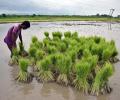
Among the key demands of agitating farmers has been a legal guarantee on minimum support price (MSP). The protest reached a crescendo when thousands of farmers from Punjab and elsewhere marched towards Delhi late last year and decided to block the main entry points once they were denied entry. The Centre, on its part, held 11 rounds of discussions with the protesters and even offered to amend some of the provisions without much success. With now one of their chief demands met, farmers have now moved on to force the government to concede on MSP.

Here are the key highlights of the BJP's 'Sankalp Patra' for the 2024 parliamentary polls.

'During times of adversity, a brick becomes better than a stone. That is how I look at the election season.'

In the coming few weeks, agriculture markets in North and Central India will be full of wheat, mustard, and chana - the three main rabi crops grown in these parts. Not only will the price trajectory of these determine the course of food inflation in the months to come, but it could also have a wider impact on the rural economy in the main growing states for these crops. Wheat and chana are largely grown in Madhya Pradesh (MP).

The irony of this scheme to benefit farmers is that it could add to the problems for the government because the mechanism to procure and store crops like pulses, coarse cereals and oilseeds barely exists.

Following are the highlights of the Economic Survey 2022-23 tabled in Parliament on Tuesday

Loans for Indian airlines have dried up as banks have become cautious to lend to the sector.

Ahead of the upcoming Union Budget, Society of Manufacturers of Electric Vehicles (SMEV) has asked Finance Minister Nirmala Sitharaman to either rejig the FAME II scheme or reintroduce FAME I, saying the programme meant to promote EVs in its second avatar has been able to achieve less than 10 per cent of its target. The Rs 10,000-crore FAME-II scheme which is to be implemented over a period of three years, came into effect from April 1, 2019. It is the expanded version of FAME India I (Faster Adoption and Manufacturing of (Hybrid) and Electric Vehicles (FAME) which was launched on April 1, 2015, with a total outlay of Rs 895 crore.
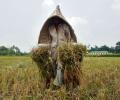
The focus is likely to be on consolidation and improvement of existing rural-centric programmes to ensure their completion ahead of the next general elections in 2019, rather than announcement of new schemes. Sanjeeb Mukherjee and Arup Roychoudhury report.

The sources further said that the government has implemented a series of interventions in the past four months to provide relief to the sugarcane farmers and to ensure clearance of their dues.

The fragmentation of politics and the pressures of coalition management have contributed to a near-secular rise in budgetary social expenditures and spending on subsidies since 1991, leaving little fiscal space for government-led capital investment.

'What is bank recapitalisation? When the rich take loans and do not return and the government returns that money to the banks.' 'What is restructuring 5:25 scheme? The government says don't return now, just tell us you will return after five years.' 'Why don't we apply these schemes to farmers?' 'I want to increase the power of farmers to blackmail the government as everyone in the country has the power to blackmail.'

The Reserve Bank left interest rate unchanged.
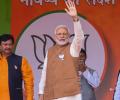
'In this country, if any government acquires one of these images -- anti-farmer, or anti-poor or corrupt -- the government doesn't survive.' 'The Modi government is fast acquiring that anti-farmer image, that is why it is nervous.'
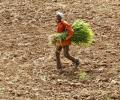
In spite of Budget's rural focus, the government has consistently stumbled in agriculture, says Shreekant Sambrani.

'We will resist it.' 'Farmers will not let that happen.'

'The policy is to consolidate farming into the hands of a few and to take away the food security of the country.' 'Once food is in the hands of 15 chosen corporate houses, you will get food, but at a price that they determine.'

Signals received from the government in the past one year reflect a state of utter confusion, says Abhishek Tripathi.
'India has an advantage because we produce more cotton and we have more workforce.'

Governments make budgets to retain and consolidate their hold on power, not to please opponents or economists. They do so by trying to gratify as many as possible without causing harm to the others, says Shreekant Sambrani.

While far from being a currency war, India does not have much of an option but to depreciate to accommodate its exports at a time when China shows its intent to let its currency depreciate.
If banks cannot charge interest from borrowers during the moratorium, who will bear that cost? Should the depositors subsidise the borrowers by foregoing interest on deposits? In that case, we will turn banking on its head! notes Tamal Bandyopadhyay.

'We need to put aside our anxieties about the Budget for now and possibly for long, and carry on as best as we can,' advises Shreekant Sambrani.

'When an enemy country is looking for information to sabotage a system from a remote location, they can access your data, they can stop the functioning of our power plants, they can stop the functioning of critical systems in the network.' 'It is very important that we should have full control of everything in the network.' 'Most Indian companies buy from China only because of the kind of incentive they are getting.' 'By doing so, these Indian companies are exposing themselves to dangers in the coming years.'

News of all that's transpired on and off the football field
 © 2026 Rediff.com - Advertise with us - Disclaimer - Privacy Policy - Sitemap - Feedback - About us - Terms of use - Grievances